Continuous refining of diamond polishing pad technology is essential to meet evolving requirements in the stone fabrication industry. For overseas diamond tool importers, stone tool distributors, wholesalers, and fabrication workshop owners, understanding material science, production methods, and quality control practices helps ensure the selected pads deliver consistent performance in granite polishing, marble finishing, and concrete polishing applications.
Material selection remains a primary driver of performance. Resin bond pads excel where high gloss and fast cutting are required, and they are commonly used across stone polishing tools for marble finishing and final-stage granite polishing. Metal bond pads provide superior durability and heat resistance for aggressive stock removal on hard granite and engineered stone. Hybrid bond systems, developed through careful formula development, attempt to balance cutting speed, gloss level, and lifespan by combining resin flexibility with metal-like wear characteristics. Control of bond formulation—including polymer matrix, metal powders, and fillers—is a core area of ongoing product improvement informed by long-term manufacturing experience.
Synthetic diamond quality grades and grit systems are equally critical. Diamonds are specified by crystal quality, particle size distribution, and friability, and these factors influence cutting efficiency and pad lifespan. Standard grit systems, ranging from coarse grits for initial grinding to ultra-fine grits for polishing, must be matched to the substrate and desired finish. Accurate control of grit progression minimizes rework and optimizes process time in stone fabrication and construction applications.
Production processes have a major impact on consistency and performance. Hot pressing and cold pressing are both used depending on the bond type; hot pressing and thermal curing are common for resin bond pads to achieve uniform density and bonding strength, while metal bond segments may use sintering or specialized powder metallurgy techniques. Hybrid pads often require multi-stage processing with precise temperature and pressure profiles. Reproducible curing cycles and tooling control are part of the manufacturing know-how developed over decades of export production.
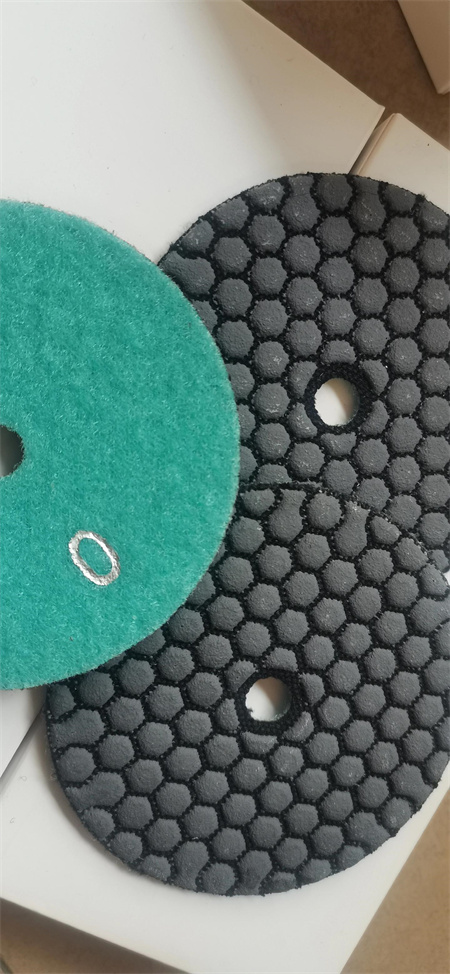
Backing systems affect usability and tool retention. Industrial-grade Velcro and hook-and-loop systems remain standard for easy pad changes on angle grinders and planetary polishers. Reinforced backings, foam layers, or mesh support can be specified by OEM customers to meet particular stability and vibration requirements in heavy-duty stone polishing tools.
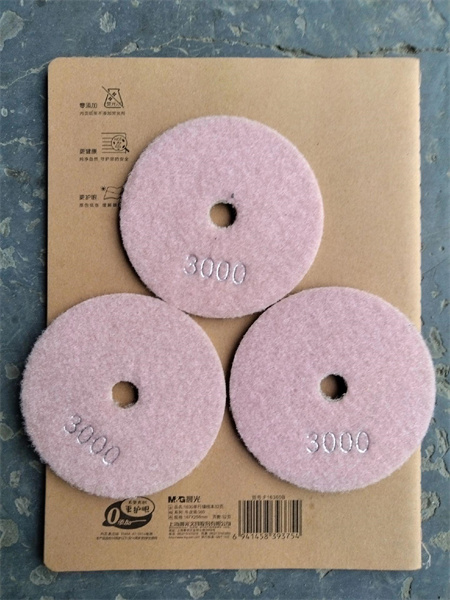
Performance factors such as cutting speed, gloss level, lifespan, and heat resistance are tested under controlled conditions. Cutting tests on representative materials, gloss measurements with calibrated instruments, and accelerated wear tests inform product grading and customer recommendations. Quality control standards emphasize batch consistency: incoming material inspection, diamond particle analysis, bond composition verification, dimensional checks, and lot traceability enable consistent output across multiple production runs. Statistical process control and documented test records support predictable supply for distribution and wholesale channels.
International export packaging practices are an often-overlooked part of product improvement. Proper packaging protects pads from moisture, abrasion, and deformation during shipment. Palletized cartons, protective interleaving, humidity barriers, and clear labeling for customs expedite handling for overseas distributors and contractors. OEM packaging options and compliance with international shipping requirements are routinely incorporated into production planning to reduce transit damage and expedite warehouse handling.
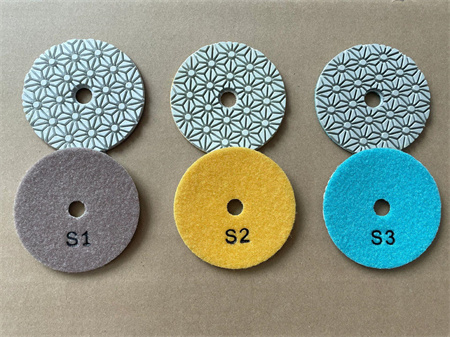
Continuous iterative improvements in materials, grit systems, manufacturing processes, and quality assurance are central to delivering dependable diamond polishing pads for the stone fabrication industry. For businesses sourcing stone polishing tools for granite polishing, marble finishing, or concrete polishing, attention to these technical and logistical details supports predictable field performance and operational efficiency.