For importers, distributors, and contractors specifying diamond polishing pads for concrete and natural stone, understanding material construction and manufacturing processes is essential to select tools that deliver consistent cutting speed, gloss level, and lifespan. Drawing on over 30 years of export experience in the stone fabrication industry, manufacturers produce pads tailored to applications such as concrete polishing, granite polishing, marble finishing, and general stone fabrication.
Bond material is a primary determinant of pad behavior. Resin bond pads are widely used for high-gloss finishing on concrete and natural stone; their polymer matrices allow controlled diamond exposure and faster gloss development. Metal bond pads offer superior abrasion resistance and are preferred for aggressive stock removal on hard granite and engineered stone. Hybrid bond formulations combine metallic fillers with polymer resins to balance aggressiveness and finishing capability, useful when a single bond cannot meet both cutting speed and final gloss requirements. Formula development for these bonds involves optimizing resin chemistry, metal alloy composition, and filler distribution to achieve targeted performance metrics.
Synthetic diamond quality and grit systems define cutting efficiency and surface texture. Most commercial pads use HPHT synthetic diamonds available in monocrystalline and polycrystalline forms, selected by hardness, crystal integrity, and micron size. Diamond concentration, particle size distribution, and bonding compatibility influence cutting speed and pad lifespan. Grit systems typically follow industry-standard ranges—from coarse grits (e.g., 30–50) for initial grinding to fine grits (e.g., 2000 and above) for polishing—allowing predictable progression through stages of stone polishing and concrete polishing workflows.
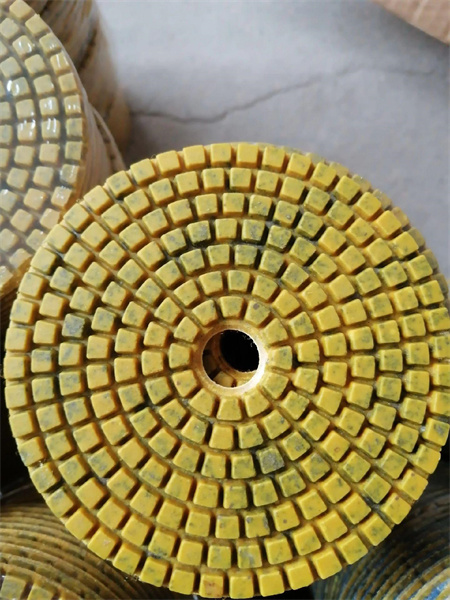
Production processes such as hot pressing, cold pressing, and controlled curing affect porosity, diamond retention, and bond uniformity. Hot pressing densifies metal-bonded segments under heat and pressure to embed diamonds securely, which is critical for high-temperature applications that demand heat resistance. Cold pressing followed by precision curing is common for resin-bond pads to maintain consistent diamond protrusion and reduce batch variability. Factory-scale production capacity supports OEM orders and private-label programs, with tooling and mold capability to produce various diameters, segment geometries, and multi-grit pads to fit different machine interfaces.
Backing systems are a practical consideration for integration with existing equipment. Hook-and-loop (Velcro) backings remain the most versatile for handheld grinders and floor machines, providing quick pad changes and reliable retention. Other backings such as pressure-sensitive adhesive (PSA) or threaded plates are available for specific machine platforms. Compatibility with common floor machines and hand tools used in the stone fabrication industry is routinely addressed during OEM design.
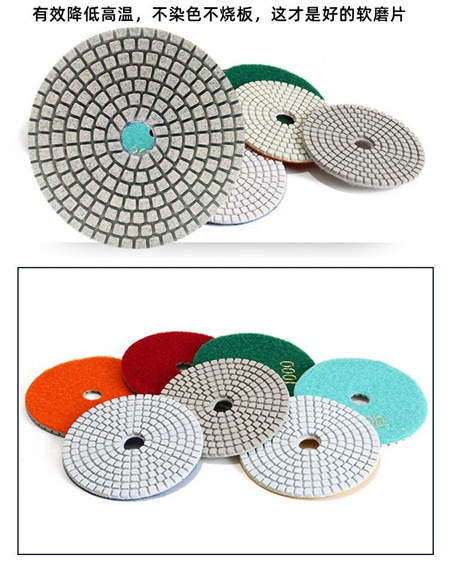
Performance validation relies on robust quality control and batch consistency practices. Most exporters implement incoming material inspection, in-process checks (including cure profiles and segment hardness), and final performance testing that measures cutting rate, gloss achieved on standard stone or concrete samples, and thermal resistance under load. Traceability, statistical process control, and sample retention are standard to ensure consistent output across production runs and international shipments.
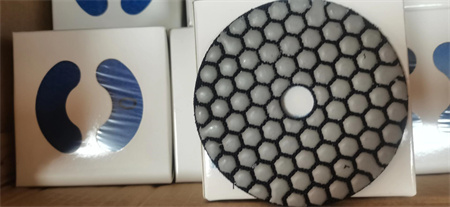
Export packaging and logistics are tailored to protect products in cross-border supply chains. Typical practices include individual pad blistering or poly bagging, carton packing with desiccants to control humidity, palletization with export-grade cartons, and adherence to ISPM-15 requirements for wooden packaging when used. Clear labeling of grit, bond type, and intended material (concrete, granite, marble) assists distributors and contractors in inventory management.
In conclusion, specifying the right diamond polishing pad requires attention to bond type, synthetic diamond grade, grit progression, production methods, and verified quality control. For international buyers and distributors, partnering with manufacturers that provide OEM flexibility, controlled production processes, and consistent export packaging supports predictable performance across concrete polishing, granite polishing, and marble finishing applications.